Showing posts with label Freeze thaw. Show all posts

Sunday, 19 January 2014

Weathering in arid environments

1) Freeze-thaw
2) Salt Crystallisation
3) Insolation
4) Wetting and Drying
5) Hydration

1. Freeze-thaw

  • Only possible where temperatures fluctuate above and below freezing.
  • Possible in semi-arid/mid-latitude environments.
1) Water enters cracks in the rocks because of rain or moisture.
2) Overnight it freezes, expanding causing the cracks to grow.
3) Eventually after repeating this process many times the cracks join causing chunks of rock to fall.

2. Salt Crystallisation
  • Would not happen in more humid environments as the salt would be dissolved by rainwater and washed away in rivers or lakes 
1) The sun (high insolation) causes the salt in solution to crystallise out of solution.
2) This causes stresses on the rock.
3) This causes disintegration in a similar way to freeze-thaw.

3. Insolation
  • Temperatures range from 80°C in daytime to below freezing in hot deserts.
1) These temperature ranges cause rock minerals to expand at different rates.
2) At night the rock minerals contract causing stresses/fractures in the surface rock layers.
3) The surface rock layers disintegrate peeling away from the boulder (known as exfoliation)

4. Wetting and Drying

Occurs when:
  • flash floods 
  • seasonal rains
  • coastal fog
  • dew
Moisture encourages clay minerals in rocks to swell. Repeated expansion on wetting and contraction on drying causes the rock to disintegrate.

5. Hydration 

Minerals absorb water which causes stress and granular disintegration.

e.g. ANHYDRITE was turned into GYPSUM (makes it more susceptible to weathering processes such as carbonation)

Tuesday, 14 January 2014

Weathering in cold environments


Processes:

There are 4 main weathering processes in cold environments-

1) Freeze thaw
2) Carbonation
3) Hydrolysis
4) Dilation/Pressure Release

1. Freeze thaw


It only occurs where the diurnal (means 24 hours/daily) temperature ranges above and below freezing. Meltwater from a glacier goes into cracks in the rocks and freezes at night expanding. This repeated action over a long time results in cracks joining up and chunks of rock falling away. This can result in scree (see below).

2. Solution/Carbonation

At lower temperatures CO2 (carbon dioxide) is more soluble in the atmosphere and can dissolve in rainwater forming a weak carbonic acid (this is more commonly known as acid rain) which reacts with limestone dissolving it. 

3. Hydrolysis

This is where in granite the H+ ions in water replace the K+ ions in feldspar producing Kaolin. If joints in the bedrock are closely spaced the increased surface area increases the extent of the hydrolysis, effectively rotting the granite.

4. Dilation/Pressure Release

This is where the removal of weight either by erosion of rock or melting of ice that reduces pressure on bedrock allowing fractures to open up.

Landforms (all located in Cairngorms, Scotland):

1) Tors
2) Blockfields
3) Scree/Talus Slopes


1. Tors:

- Found in Iach Bun Rudhtair, Ben Avon, Cairgorms
- Rocky outcrops up to 5m tall
- Classic weathering landform
- Debris found at the base of tors is commonly known as clitter.
- What remains after constant hydrolysis of the bedrock.
- Can occur after a glacier has melted and dilation has occurred. 


2. Blockfields:

- Found at the summit of Ben Macdui, Cairngorms
- Areas of flatland/gentle slopes where there is scree (also known as frost-shattered material) the result of freeze thaw weathering breaks up the surface into large boulders. These remain in situ.


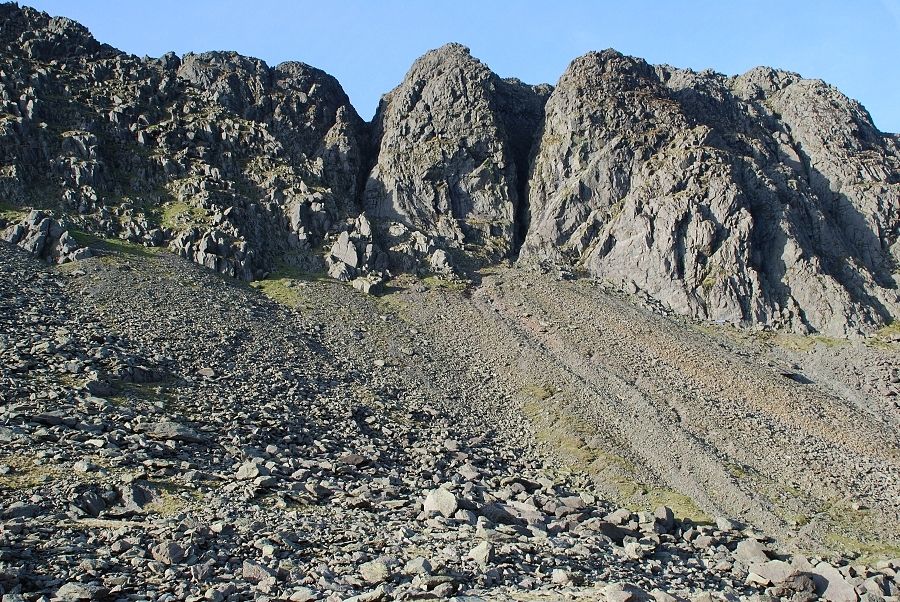
3. Scree/Talus Slopes


- Found at Lairig Ghru, Cairngorms
- Scree is tiny bits of frost-shattered material.
- A scree slope is where the material collects at the foot of a vertical cliff or free-face.
- The slopes show a degree of sorting with particles increasing in size downslope.