Showing posts with label Cold Landforms. Show all posts

Tuesday, 14 January 2014

Glacial Deposition

Why does it occur?

1) Direct (or ice contact)- during deglaciation/frictional resistance to flow is high
2) Glacial Meltwater streams

Moraine is one product of deposition. Moraine is defined as lines of loose rock fragments which have been weathered from the valley sides above the ice, and have fallen downslope onto the ice.

Types of Moraine:

1) Supraglacial (surface moraines)
2) Englacial (debris carried within the glacier)
3) Subglacial (basal moraine)
4) Lateral (debris deposited alongside the glacier)
5) Medial (debris deposited between two glaciers)
6) Terminal (debris deposited at the end of a glacier)

Factors affecting moraine;

1) The amount of material carried by the ice 
2) The rate of ice movement
3) The rate of ablation and thus the amount of meltwater

A general term for glacial deposits is 'till' which is sometimes written as 'drift' on some maps. There are two types:

1) Ablation (left in situ)
2) Lodgement (left in lines in the direction of flow)

Words to use when describing till;

Unstratified
Unrounded
Unsorted
Unconsolidated

Landforms:

1.Erratics:

Large boulders foreign to the local geology that have been dumped by the ice, usually on flat areas (can be left stranded in precarious positions as perched blocks).


2.Drumlins:

Where a valley glacier flows into a lowland plain (causing a thinning of ice), the till has been deposited as small, oval mounds. 


Weathering in cold environments


Processes:

There are 4 main weathering processes in cold environments-

1) Freeze thaw
2) Carbonation
3) Hydrolysis
4) Dilation/Pressure Release

1. Freeze thaw


It only occurs where the diurnal (means 24 hours/daily) temperature ranges above and below freezing. Meltwater from a glacier goes into cracks in the rocks and freezes at night expanding. This repeated action over a long time results in cracks joining up and chunks of rock falling away. This can result in scree (see below).

2. Solution/Carbonation

At lower temperatures CO2 (carbon dioxide) is more soluble in the atmosphere and can dissolve in rainwater forming a weak carbonic acid (this is more commonly known as acid rain) which reacts with limestone dissolving it. 

3. Hydrolysis

This is where in granite the H+ ions in water replace the K+ ions in feldspar producing Kaolin. If joints in the bedrock are closely spaced the increased surface area increases the extent of the hydrolysis, effectively rotting the granite.

4. Dilation/Pressure Release

This is where the removal of weight either by erosion of rock or melting of ice that reduces pressure on bedrock allowing fractures to open up.

Landforms (all located in Cairngorms, Scotland):

1) Tors
2) Blockfields
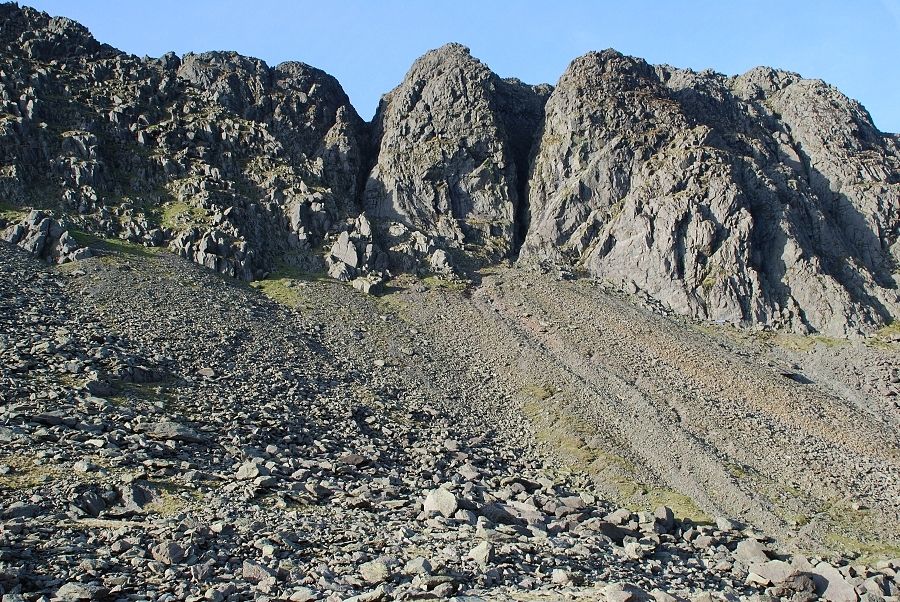
3) Scree/Talus Slopes


1. Tors:

- Found in Iach Bun Rudhtair, Ben Avon, Cairgorms
- Rocky outcrops up to 5m tall
- Classic weathering landform
- Debris found at the base of tors is commonly known as clitter.
- What remains after constant hydrolysis of the bedrock.
- Can occur after a glacier has melted and dilation has occurred. 


2. Blockfields:

- Found at the summit of Ben Macdui, Cairngorms
- Areas of flatland/gentle slopes where there is scree (also known as frost-shattered material) the result of freeze thaw weathering breaks up the surface into large boulders. These remain in situ.


3. Scree/Talus Slopes


- Found at Lairig Ghru, Cairngorms
- Scree is tiny bits of frost-shattered material.
- A scree slope is where the material collects at the foot of a vertical cliff or free-face.
- The slopes show a degree of sorting with particles increasing in size downslope.