Showing posts with label Cold Environments. Show all posts

Wednesday, 26 March 2014

Tundra


What is it?

Is biome where the tree growth is hindered by low temperatures and short growing seasons

Where is it?
On the map it is represented in the orange and is mainly found in Iceland, Canada and Norway. There is also alpine tundra where high altitudes create similar conditions to those found at high latitudes (e.g Rockies, Himalayas, Alps)

PLANT ADAPTATIONS:

How does a short thermal/hydrological growing season affect tundra plants?

Problem= Plant growth only begins when there is an air temperature of 6°C. The growing season only lasts 1-2 months, and the life cycles of the plants are completed very quickly resulting in an environment with a low NPP. 

Adaptions:
  1. Most of the plants are perennial and store food in tubers and rhizomes during summer which then allows for rapid growth in the Spring.
  2. Many of the plants are evergreen and therefore have no need to grow new leaves, their dark leaves absorb insolation which they can then use to photosynthesise.
  3. Some of the flowers form buds a year in advance so then don't waste time in the growing season
How has the Arctic poppy adapted?
  • Turns the head of the plant to follow the sunlight 
  • Low-lying=limits evapotranspiration=reduces water loss
How has the Purple Saxifrage adapated?
  • Is perennial so can live for many years
  • grows on shallow soils and bare outcrops
  • Leaves are covered in dense hairs (Retains heat)
  • Grows in dense clumps (reduces wind resistance)
  • Can self-pollinate (there are few pollinating insects around in early spring) 
How does the climate and type of vegetation affect the soils?

Mainly made up of gley soils which easily become waterlogged. This reduces the amount of oxygen and ferric/ferrous compounds. There is also the problem of leached minerals this is due to there being more rainfall than evaporation causing the leaching of minerals downwards leading to an elluviated zone with few minerals and hardpan lower down due to the accumulation of minerals.

ANIMAL ADAPTATIONS:
Byson:

Behavioural:
  • Migrate
Physical:
  • Large volume:surface area ratio (reduces heat loss)
  • Long nostrils (warm up air that enters into the body)
  • Extremely dense coat
Arctic Foxes:

Behavioural:
  • Migrate but have home dens
Physical:
  • Can survive -50°C
  • Best insulating fur
  • Increased blood circulation to their paws

Why are cold environments considered to be fragile?

Why is NPP low in cold environments?
  • Limited insolation from sun due to curviture of the Earth, leading to low amounts of photosynthesis
  • Very short days in winter due to tilt of the Earth
  • High winds=High transpiration rate+plant damage due to abrasion
  • Unavailable water 
  • No/thin soil due to lack of weathering+low NPP meaning limited minerals and nutrients
How does this make these environments fragile?
  • Limited insolation=plants are limited in photosynthesis=lack of energy available=if destroyed can't be replaced (due to low NPP and recovery rates)=leading to a high proportional impact

Tuesday, 14 January 2014

Different Glacial Environments

There are 3 different types of glacial environments:

1) Polar
2) Periglacial
3) Mountain

1. Polar Climates

- Typically cold and dry all year
- High variations in precipitation rates
- High katabatic winds (Katabatic winds are cold mountain winds-the dense air flows down from the mountains to the lowlands chilling the ground as it passes over
- Found in a high pressure belt means that there is sinking air and therefore the air has a limited moisture holding capacity meaning there is unreliable and sparse rainfall
- Albedo (80-90%) reflection of insolation (e.g Greenland)

E.g Antartica 

2. Periglacial Climates

- Have significant cover of snow and ice but not all year round 
- Found in areas of high altitude and latitude 
- Large seasonal temperature ranges (winter=below -50°C, Summer=above 20°C)
- Low precipitation rates because of the low air temperature meaning a limited moisture holding capacity
- Located within a high pressure system and next to a glacial environment and is influenced by them.

-Reasons these areas are cold:

1) High latitude: they receive low insolation due to the curviture of the Earth.

2) High altitude: temperature declines on average 1°C per 100m
                        gained, also the moisture holding capacity is reduced.

3) Albedo: Areas that reflect solar radiation (only absorb 10-20%)

3. Mountain Climates

- They are cool they lose about 1°C per 100m gained
- They are wet due to orographic rainfall (Rain that is produced as air is forced to rise over high ground such as a mountain barrier, it subsequently cools. Condensation occurs and precipitation is produced)
- The air also thins the higher you get.


Weathering in cold environments


Processes:

There are 4 main weathering processes in cold environments-

1) Freeze thaw
2) Carbonation
3) Hydrolysis
4) Dilation/Pressure Release

1. Freeze thaw


It only occurs where the diurnal (means 24 hours/daily) temperature ranges above and below freezing. Meltwater from a glacier goes into cracks in the rocks and freezes at night expanding. This repeated action over a long time results in cracks joining up and chunks of rock falling away. This can result in scree (see below).

2. Solution/Carbonation

At lower temperatures CO2 (carbon dioxide) is more soluble in the atmosphere and can dissolve in rainwater forming a weak carbonic acid (this is more commonly known as acid rain) which reacts with limestone dissolving it. 

3. Hydrolysis

This is where in granite the H+ ions in water replace the K+ ions in feldspar producing Kaolin. If joints in the bedrock are closely spaced the increased surface area increases the extent of the hydrolysis, effectively rotting the granite.

4. Dilation/Pressure Release

This is where the removal of weight either by erosion of rock or melting of ice that reduces pressure on bedrock allowing fractures to open up.

Landforms (all located in Cairngorms, Scotland):

1) Tors
2) Blockfields
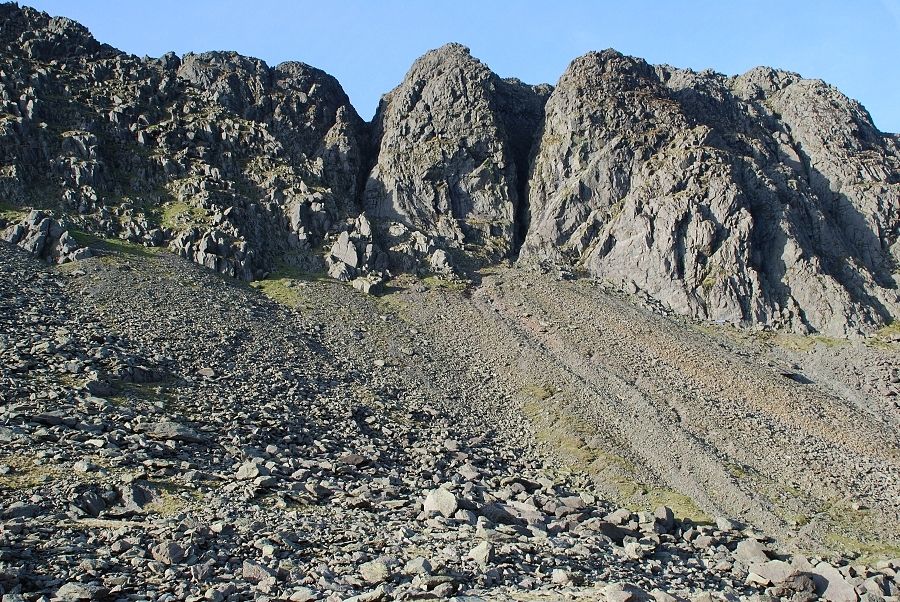
3) Scree/Talus Slopes


1. Tors:

- Found in Iach Bun Rudhtair, Ben Avon, Cairgorms
- Rocky outcrops up to 5m tall
- Classic weathering landform
- Debris found at the base of tors is commonly known as clitter.
- What remains after constant hydrolysis of the bedrock.
- Can occur after a glacier has melted and dilation has occurred. 


2. Blockfields:

- Found at the summit of Ben Macdui, Cairngorms
- Areas of flatland/gentle slopes where there is scree (also known as frost-shattered material) the result of freeze thaw weathering breaks up the surface into large boulders. These remain in situ.


3. Scree/Talus Slopes


- Found at Lairig Ghru, Cairngorms
- Scree is tiny bits of frost-shattered material.
- A scree slope is where the material collects at the foot of a vertical cliff or free-face.
- The slopes show a degree of sorting with particles increasing in size downslope.